

Mayabunder Through Web-Builders, Active Hunters and In-Betweeners!
Updated: Feb 14
This is a reflective field story from Mayabunder where local life and spider ecology intertwine, showing how web-building, hunting, and cryptic spiders reveal deeper connections between community, curiosity and the forest.
In the Karen village spread across the stillness of Mayabunder, life announces itself in small, deliberate movements: Cicelia aunty stirring chicken and rice for a communal meal; children leaping down steps two at a time to ward off ill-luck; machans covered in dry fish and chillies; Ahti John in his garden of medicinal plants; elders weaving mats with pandanus leaves; Wenji mimicking birdcalls; verandahs becoming midday sanctuaries of filtered light and ngapi.
Yet amidst the pages of these days, something else caught my eye too - eight legs at a time, revealing the forest not as a backdrop but as an interlocutor. Spiders, both familiar and strange, became my bearers of attention, reminding me that the world grows larger when we learn to look smaller.
This is a story of web-builders, active hunters, and those in-between - and of a village whose heartbeat, like the spiders’, is held by threads both fragile and resilient. This is a story of ecology and culture, but most of all, this is a story of curiosity.
It’s the first day of our program at Local Voices in Conservation, and we have been tasked with finding Andaman Karen Crafts using only clues from the landscape around us: two mounds of boulders ahead, a pynma tree straight opposite, a towering fruit-laden imli tree behind, and, off to the left, a quiet duck-filled pond.


I walk towards a zinda balli fence and see my first jumper - Phintella sp. The tiny metallic-blue jumper remained reasonably calm until it detected the presence of weaver ants, at which point it quickly retreated to the underside of a leaf to avoid them. This jumper spends much of the day wandering in search of prey. As an active hunter, it encounters more than just potential meals. Sometimes, it also comes across potential threats like the weaver ants! Fortunately, its agility, rapid movements, and ability to leap many times its body length serve it well both in capturing prey and escaping predators.


The next two spiders that I chanced upon were the orb-weavers in Rahul’s garden (a haven for orchids and spider webs) - Laglaise's garden spider (Eriovixia sp.) and the Asian spiny-backed orb weaver (Thelacantha sp.) The garden spider’s web was tethered on one side to a supari tree and the other to a fence, perfectly positioned for a life alongside humans. It sat quietly at its centre, moving only when it sensed a disturbance - slipping to the other side of the web through a well-placed portal (read: a hole in the middle). Web-builders like these excel at letting their food come to them! As sit-and-wait predators, they invest effort in constructing their webs, and then kick back and relax until an unsuspecting insect flies into the trap! They only move when necessary: to fetch any prey snagged in the silk or to evade predators, or occasionally, to take a few cautious steps away from curious humans.


During one of our daily observation sessions on the fourth morning of the program, we were given a prompt to choose our favourite tree and observe its bark closely, noting three things that we found fascinating. I chose the tamarind tree right behind AKC. I observed a caterpillar, a tiny egg sac of something, and a spider. The spider was almost the exact colour of the bark, beautifully camouflaged. It had eight legs, as usual, but also two tails, which made it look like it had ten legs.
While observing it, an elderly Karen person asked me, “Kya dekh rahi ho?” (What are you looking at?) I said, “Spider dekh rahi ho.” (I’m looking at spiders) He said, “Jungle mein toh bohot bada bada spider milta hai, jungle main jao.” (You must go to the jungle, there are bigger spiders there.)
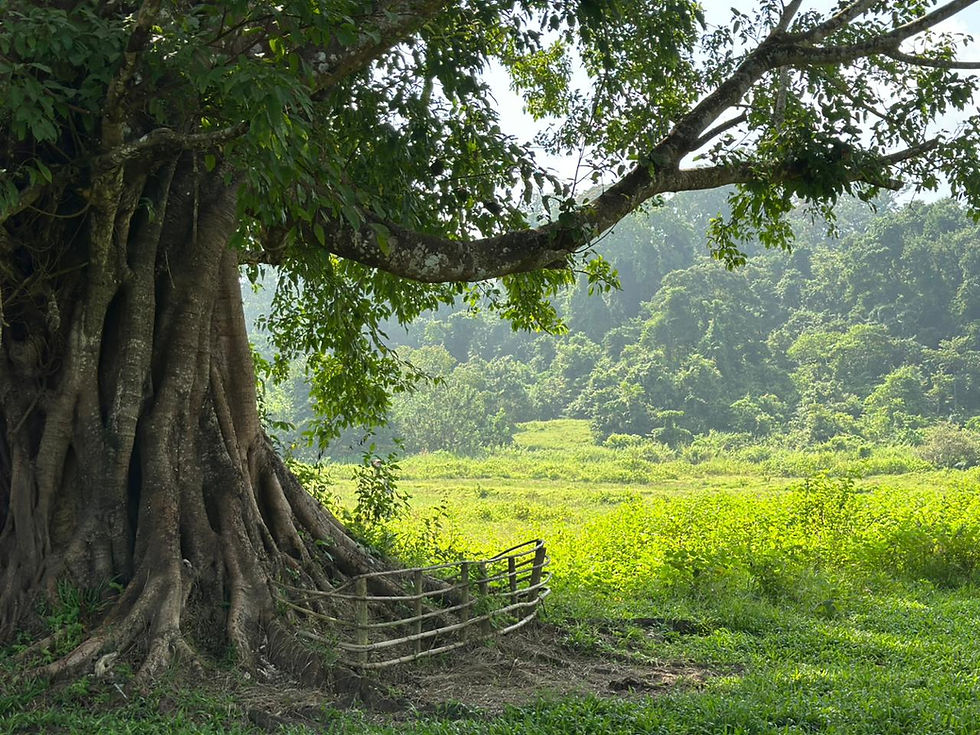
Fresh from this interaction, I moved my attention to the old eight-legged male perched on the bark. It was brown in colour with slight stripes. Another twin-tailed spider sat just beside it - grey with bold black stripes. These beautiful spiders rest on tree barks, waiting patiently for an insect to wander close enough. Thin strands of silk running along the bark act as pressure sensitive tripwires, alerting the spider to the presence of potential prey. In this way, the twin-tailed spider walks both worlds: a sit-and-wait predator that becomes an active hunter the moment an opportunity appears. Its blend of mottled and striped patterns creates a near-seamless camouflage (at least to my eyes). Both of them sat still, asking me in unison, “Kya dekh rahi ho?” (What are you looking at?)


It was a day of feasting at Wenji’s. A naturalist with more than three decades of conservation experience and a deacon at his local church, Wenji is considered a legend among researchers for his uncanny ability to read the land, and offer the exact guidance fieldwork demands. Creatures seem to find him, as much he finds them.
The day felt as though it was bursting at the seams — literally, from all the incredible food, and figuratively, from the sheer joy of sharing a meal facing his beautiful garden.
After eating, I wandered into the garden to look for critters. Wenji’s granddaughter showed me a leaf and said “Yeh sabun patti hai” (This is soap leaf). “If we don’t have soap, we bathe using this,” she explained. She asked me to pluck a leaf and rub it. It began to foam just like soap, and it smelled delightfully fresh.

While observing a leaf, I came across a caterpillar which Krishna identified as Dysphania sp. Beside it, staring into something beyond my human comprehension, sat a lynx spider (Oxyopes sp). These spiders are yet another reminder of how difficult it is to categorize a spider’s hunting strategy. As with many things in nature, hunting behaviors exist on a spectrum. The lynx spider, for example, occupies the middle ground - sometimes waiting on a flower for pollinators, and at other times darting off a fly that happens to land on a leaf nearby.

I was strolling with Rahul, when we went to visit Wenji’s pig. A big fellow whose constant oinks rose into loud, impatient grunts. As I watched the pig, my eyes drifted to a spider curled inside a bowl-shaped web, positioned in such a way that it appeared to have willingly imprisoned itself. Comb-footed spiders are known for this behavior - they have a penchant for taking fallen leaves and creating an extra layer of fortification to their already maze-like 3-D webs!
I stood there, caught between a tree branch holding a spider that had enclosed itself and a sty where a pig struggled to break free — amused by the irony of one creature embracing confinement while the other resisted it.
I returned to the verandah where I heard Wenji’s wife telling her granddaughter to study. Instead, she ran into the forest. Following her, I spotted another spider - a spiny-backed orbweaver with bright yellow and black stripes.

This was only my second time seeing one - the first had been near AKC, and the second here at Wenji’s home. Nearby, a gunny bag full of mussels had been left out. The smell pushed me to step out of the wind’s path, and that small move led me to yet another orb-weaver - a white-and-black spiny orb-weaver!

I sat beneath it for a while, studying its silhouette. The shadows of its spikes looked as though it were wearing a crown of thorns. As it wove its nest near Wenji’s mango tree, laden with orchids, I followed its trail.
While I was absorbed in watching the spider, an Andaman green bronzeback snake appeared before me, staring straight at my face. The moment I acknowledged its presence and leaned back, it plunged to the ground right in front of me.
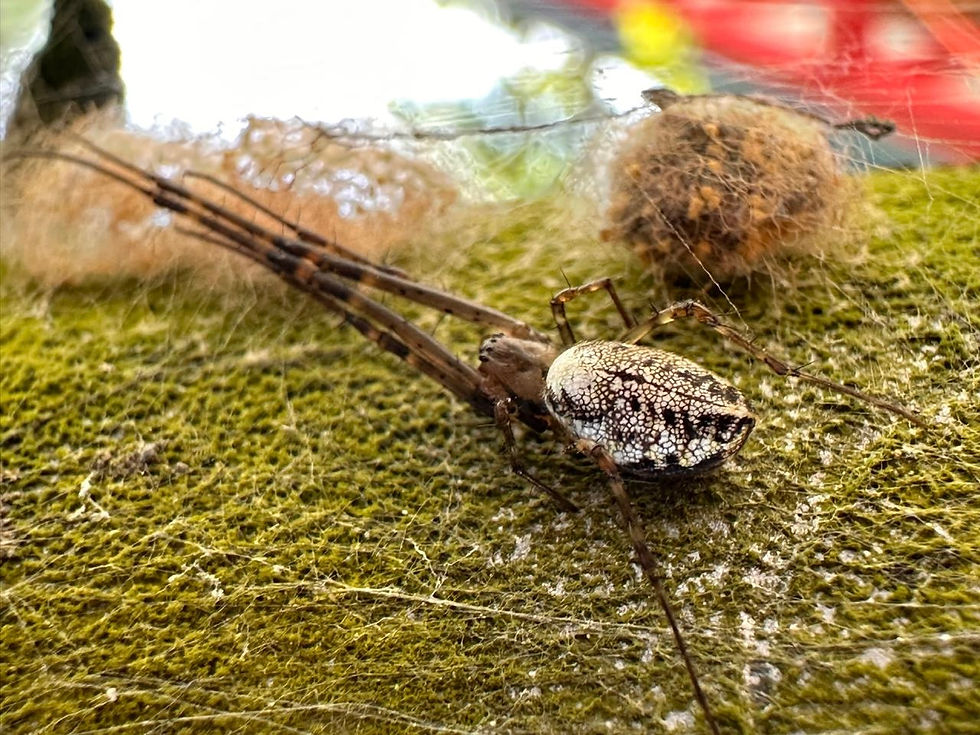
For our final day’s event, we had every participant join the iNaturalist Bingo activity. One of the prompts was “something with eight legs”. I was leading a group of six girls. “Let’s look for a spider!” they said. Soon, one of them spotted a long-jawed orb-weaver on a moss-covered railing. When they are not on their horizontal orb-webs, long-jawed orb-weavers spend their time resting in cryptic positions like this - hiding on leaves, moss, branches and in some cases even on wires! Around the spider were eight egg sacs. With that discovery, the girls completed their activity and shouted, “Bingo!”
Looking at Mayabunder through this lens, the community is part of a larger cosmic architecture, where the people and the spiders share a forest and are bound by an unnamed kinship. Both build with patience rather than force; both survive by sensing the slightest shifts in their environment; both understand intuitively that a home is something you craft thread by thread.
Krishna and Local Voices in Conservation not only gifted us this vantage point to see our islands anew, but also reminded us of the patient work required to protect the place we call home. And of the innumerable people who have submitted their lives to the quiet act of safeguarding a land whose essence they carry in their bones.
I would like to thank the partners and supporters of Local Voices in Conservation: The Habitats Trust, Andaman Karen Craft Centre, Andamans Conservancy Foundation, ANET, Dakshin Foundation and Andaman Avians Club, whose generous donations, contributions, and expertise made this program and experience possible.
Thank you, Samuel John, for your valuable insights and your genuine love for spiders. Without your passion and guidance, this piece would not have been possible, nor would I have gained such a deep understanding of them. Thank you for writing this with me.
About the author
Priya is a local girl from Havelock who is both an engineer and an educator. She has been teaching island kids for the past 3 years. She has helped and supported more than 300 children with school and empowered them to realize their dreams and ambitions.
Sharing is caring.
Share your thoughts with us in the comments section below.
Use the links below to share this story on your social networks.



Comments