

Discovering the Hidden Microcosm With Island Children
In this piece, Foldscopes (paper microscopes) in the hands of curious kids turn the ordinary into something worth looking at a little more closely.
The children were filled with excitement when they first heard they would be using a microscope. But this was not an ordinary microscope. It was made of paper. When I told them it was called a Foldscope, their curiosity grew instantly. That evening, many of them went home and searched for information about it, wondering what hidden details of the world they might discover through such a tiny device.
The next day, as the session began, John guided the children step by step as they carefully assembled their foldscopes. Soon, each group held a small microscope in their hands, ready to explore. That day’s session focused on dry samples. The children eagerly collected flowers, leaves, dead insects, and anything else they thought might reveal something interesting under magnification.


Toma found a dead dragonfly. She carefully removed one of its wings and prepared the slide. When she looked through the foldscope, her face lit up with wonder. “It reminds me of the geometry from my maths book,” she said. “I see quadrilaterals, pentagons and hexagons.” She noticed that at the points where the shapes met, there were tiny hair-like structures.
On the other side, Ranbeer was observing the wing of a mosquito. He called out to Toma, “Look at this! My mosquito wing is covered fully with tiny hair. I never knew mosquito wings had hair on them.”


Palash discovered a palm leaf that had aphids on its underside. Curious to examine them more closely, he placed the sample under the foldscope. Under magnification, the aphids appeared as oval-shaped forms with delicate geometric patterns within them, surrounded by stomata on the leaf surface.


Sourabhi plucked a petal from a balsam flower. When she looked through the foldscope, she described the cells as looking like tiny purple gemstones arranged side by side.
Soon, the entire room buzzed with discoveries. Students examined pollen grains, anthers, insect legs, soil particles, and even particles of sand. Each sample revealed a hidden beauty that they had never imagined before.

The next session focused on wet samples. The students collected water from many sources: ponds, tanks, RO water, sea water, and stagnant puddles nearby. Preparing wet samples was more challenging. The water had to be kept in place without spilling, and John showed us a few clever jugaad to make it work.
Dinesh collected water from a nearby field and carefully prepared his slide. When he looked through the foldscope, he discovered hundreds of tiny larvae wriggling in the water. The realisation that living microscopic creatures existed in something as ordinary as a drop of water filled everyone with amazement. From that moment on, their curiosity only grew stronger.


The following day brought another beautiful moment of learning. The senior students led the session and taught the juniors how to assemble and use the foldscope. Watching these young teachers share what they had learned with confidence and enthusiasm was truly heartwarming.
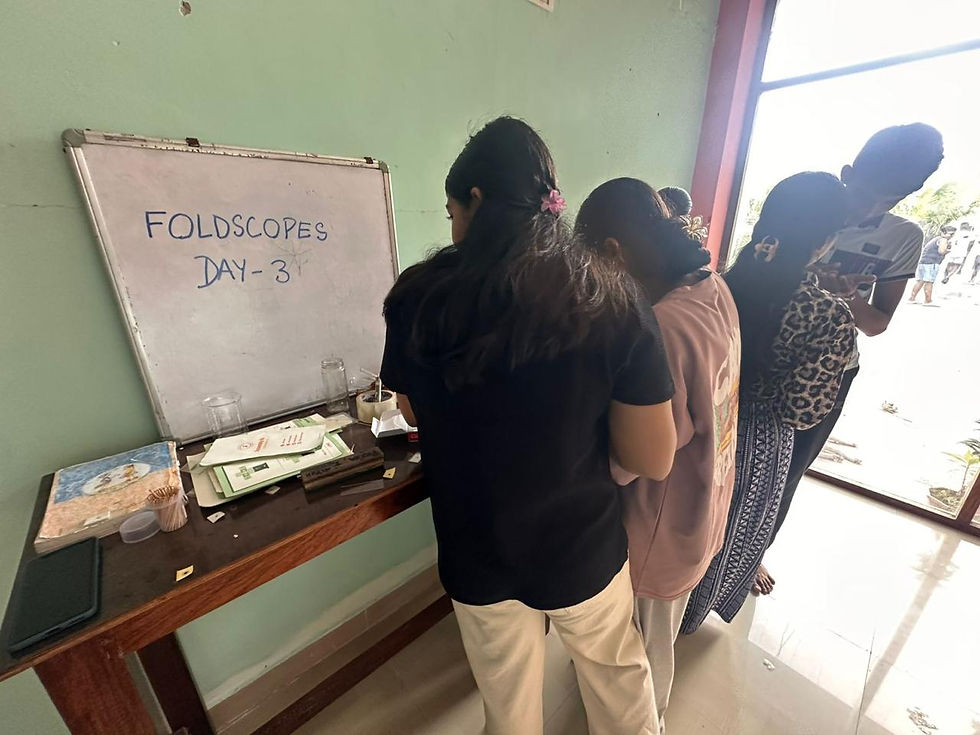
Soon, the children wanted to go further. They decided to work on small projects in groups. Some groups focused on water samples, others studied insect wings, soil particles, insects themselves, or the microscopic structures of leaves and flowers.
Srijeet, Abir, and Joydeep chose to study water samples. They borrowed a foldscope and continued their observations at school. They shared their experiments with the rest of the class at school, which got other kids interested. During recess one day, they ran up to me, almost out of breath with excitement.
“Didi!” they said. “We collected stagnant water from a puddle in the school and saw a J-shaped larva floating! It was fluorescent. We didn’t have phones, so we drew it on a sheet of paper.”

Their excitement was contagious. Every group returned with new observations and new questions.
What began as a simple activity with a paper microscope slowly transformed into something much bigger. The foldscope did more than magnify tiny objects; it magnified the children’s curiosity, their sense of discovery, and their confidence to explore the unseen world around them.
I would like to extend my sincere gratitude to Spiders and the Sea for making this initiative possible. I would also like to thank the NCBS Science Education and Outreach Office for their generous grant of Foldscopes, which gave the project both direction and purpose. The Foldscope is a simple yet powerful innovation that makes science accessible by turning a sheet of paper into a window to the microcosmos.
TEL is a space that brings science out of formal laboratories and into everyday life. Inspired by frugal science, low-cost tools, and grassroots innovation, we aim to allow anyone to observe and investigate the natural world. It focuses especially on hands-on discovery, encouraging students, nature enthusiasts and citizen scientists to see that meaningful inquiry can happen anywhere.

About the author
Priya is a local girl from Havelock who is both an engineer and an educator. She has been teaching island kids for the past 5 years. She has helped and supported more than 400 children with school and empowered them to realize their dreams and ambitions. Tidepooling and learning about the natural world are not just things she enjoys; she loves it so much that now the crabs ID her by her scientific name.
Sharing is caring.
Share your thoughts with us in the comments section below.
Use the links below to share this story on your social networks.


I am amazed... I hope the children carry this curiosity along with them wherever they go.