

Roots Show the Way: Meghalaya’s Living Bridges
Updated: Apr 4
In this misty state, the author shares her personal discovery on how roots grow into bridges, and the forest decides the path we take.
Jingkieng Jri, as the Khasi fondly call them, derives from Ka Jingkieng Ksiar, which roughly translates to the “golden root ladder.” In oral folklore, these mythical bridges are said to connect the earth to the sky, through which celestial beings descended from the heavens. Colonial-era explorers discovered and documented the root bridges during surveys in the 1840s, though local communities insist that their origins long predate any written record. A remarkable feat of bioengineering by the Khasi and Jaintia tribes, their creation is a slow and deliberate process involving the shaping of Ficus elastica tree roots. Construction is deeply communal, with knowledge passed down through lived practice, reflecting an enduring relationship between people and the landscape. These bridges remain an integral part of the cultural identity and ecological wisdom of indigenous communities.
It is a bridge. Kind of.
You walk on it from one end to the other, yet it isn’t stone. It is something alive, and that life begins with a tree.

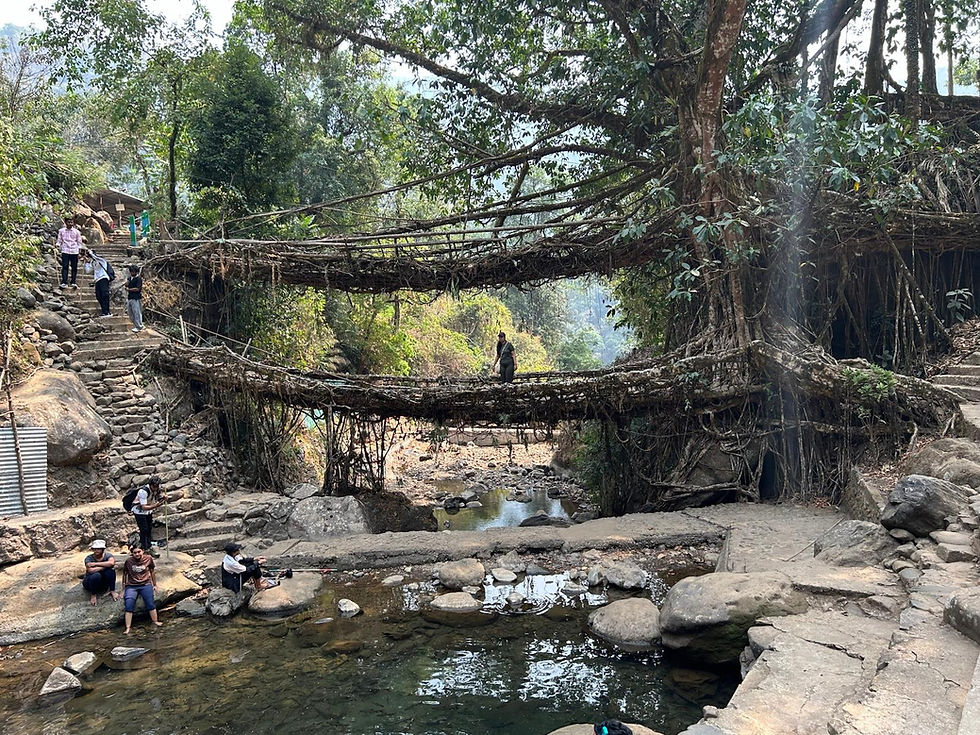
I am in the village of Seij in Cherrapungi. In a hilly region like this, roads are often impossible. The alternative is paths, tracks and the mid-air gaps between the trees.
I stand at one of these gaps in Umkar, beneath a tree known as the Indian rubber tree. I am no botanist, but Siang Koch, my guide who knows Meghalaya like family, calls it so. The tree originally rooted itself in the soil, and gradually, its roots reached the edge of a valley, a deep ditch, or a riverbank.
And then they paused.
The tree towers above me as I stand at the edge of a fairly deep ditch. The bottom is covered entirely with rock and granite. Not even a blade of grass can survive here. It is impenetrable terrain for roots, yet the tree continues to grow. That is when the root bridge begins to take shape and come to life.
About a hundred years ago, this main root was gently stretched across the ditch until it reached the other side, where it touched soil and carried on growing. More roots branched off, and even more roots emerged. Each root was woven across a gap. The roots intertwine like braids of hair, and like hair, they keep growing. Hence the name Root Bridge.
(Left) A dense network of aerial roots spreads outward, gradually binding together through natural grafting to form a stable base. (Right) The matured bridge reveals a walkable surface, with roots guided into railings.
Photos by Siang Koch.
There seems to be some difference of opinion on who performs the weaving. In some villages, certain families take on the task and pass down the skills and knowledge to the next generation. According to Siang, anyone could take an aerial root, weave it around another, and attach tender branches to stronger ones. I tried it myself, clasping the most delicate root and weaving it around a sturdier one nearby. The root may only stretch a few inches at first, but over time, it gains strength and intertwines with others.
The bridge I stand on has hundreds of roots, firm and strong, capable of bearing the weight of people across to go to markets, work or visit friends.
I gaze at the roots that clutch the rocks. They grow over them, hug them until they reach soil, and then find enough earth to continue growing.

It looks like the matted hair of a giant who has gone to sleep and not bothered to wake up. The giant lies on the ground, arms stretched far and wide, fingers growing into the earth. This giant has made a bridge for us.

Siang tells me there are hundreds of root bridges like this in Meghalaya. I ask how one decides which tree will be used to create a root bridge.
“The root shows the way,” he says. “People do not control the tree. It is the tree that decides.”
I am humbled by that response. After crossing, I cannot bring myself to walk back on the roots. I am treading on a living, breathing entity, and I do not want to step on its life.

About the author
Lakshmi Williams is a 76-year-old explorer who lives in Lowestoft, Suffolk, the easternmost town in the UK. The North Sea is her neighbour. Very nice, you may say - but wait till you meet The Beast from the East: Siberian winds that hit the coast in winter. Her garden is east-facing, largely ruled by plants that refuse to behave. Beasts and birds are welcome, but human friends fear to tread. Walk softly, you could be stepping on a plant.
Sharing is caring.
Share your thoughts with us in the comments section below.
Use the links below to share this story on your social networks.


Beautifully written.
These root bridges are magnificent.
Beautiful!